Showing posts with label exercise. Show all posts

Friday, June 28, 2013

Outdoor Summer Exercise


We love the summer. It gives us more opportunities to get outdoors and exercise. To break from your normal summer  exercise regime or to try something different, we wanted to give you some new outdoor exercise options. Here are our findings.

1.Skipping-rope. Haven't skipped rope or played a little Double Dutch with your friends since you were in grade school? Well, it's time to pick up an old habit. It's fun, trendy, and family-friendly. Get the kids involved and get everyone's fitness curve on the upswing. Women all around the country have rediscovered jump-rope, both as a means of getting in shape and as a healthy form of competition. There are exhibitions and festivals going on throughout the United States and Europe. As for weight loss, twenty minutes of jumping is the equivalent of an hour of aerobics. The best part is that skipping-rope is a great lower-body workout.

2. Geocaching. This fun, walking-intensive activity - essentially a technological scavenger hunt - is sweeping the nation. All you need to participate is a hand-held GPS device. Here's how it works: people hide objects almost anywhere you could imagine (the caches), and list them online only by their latitude and longitude. Geocachers become members of these online groups and select caches to find based on general location and difficulty of the search. Caches are inexpensive, fun and quirky. When you find a cache, you leave something else for the next person. To learn more, go to www.geocaching.com.

3. Yoga at dawn. For you early risers, join the ranks of yoga enthusiasts who
spread their mats on the beach as the sun makes its appearance for another day. Yoga has both physical and psychological benefits that often seem enhanced when combined with awe-inspiring natural events. Alternatives to practicing your asanas (yoga poses) at dawn include yoga in the moonlight and yoga in a quiet glade.

4. Fitness trails. Instead of simply biking, jogging or hiking, check out a fitness trail near you. Fitness trails are paths that have a series of stations featuring different exercises. As you jog down the trail, you periodically come upon a chinning bar, parallel bars or, perhaps, a horizontal ladder, all designed to give a different part of your body a workout. Fitness trails are often sponsored by colleges, community groups or your city government, so there's probably one nearby.

5. Amateur leagues. It may seem as if we've become a nation of couch
potatoes, getting our thrills vicariously through our local university or professional sports teams. In reality, amateur participatory sports are alive and well. If you love baseball, why not find a local league designed for people just like you? Most cities and towns have organized programs in baseball, softball, basketball and soccer that are perfect for adults and kids of all ages. It's great weather for sports, so join in, have fun and get fit.


 This list should assist you with more exercise choices this summer. Thank you to netquote.com for their insight concerning this topic.  If you would like to contact us with any questions or feedback, you can reach us by email.

Thank you for visiting!
Joseph A. Jones & The WellLife Team


Monday, October 15, 2012


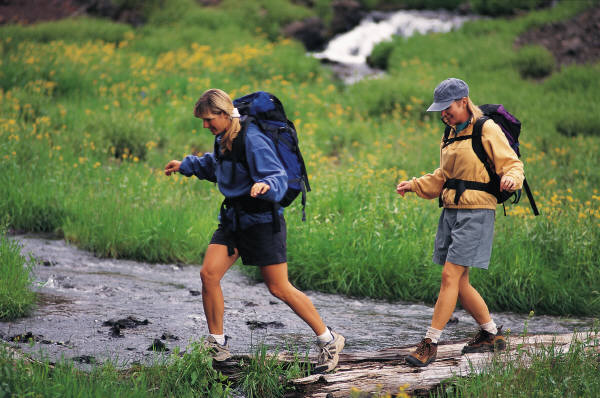
Doesn't that look relaxing. Nature walks are a wonderful way to exercise and to relax at the same time. Now, they even have evidence showing all of the health benefits of this form of exercise. Here is what they found.


Scientists have some advice for you. Advice, it turns out, that your mother already told you a long time ago: Go play outside.But, it turns out mother was only partly right. John Jonides, University of Michigan professor of psychology and neuroscience, and graduate student Marc Berman have one big condition to that advice: A walk in nature sharpens the mind, but a walk in the city does not.


They found this out by performing an experiment that they published in the journal Psychological Science. They gave volunteers memory and attention tests and then sent them out on a walk. Sometimes they got instructions to walk in the university’s urban home of Ann Arbor and other times they walked through a nearby arboretum.


Berman says they then tested their memory and attention again and “found that when the participants returned from the nature walk, they showed a 20 percent improvement (in the tests) but showed no improvement when they returned from the urban walks.”


Why the difference? It has to do with something called the Attention Restoration Theory. It says we all have two kinds of attention. Directed attention is when we pay attention to something because we need to — like work, or school, or something else that takes a lot of concentration. We eventually tire, often lose focus, and need to take a break.


The other kind is “involuntary attention.” It captures your attention simply because it interests you. What’s interesting might vary from person to person, but as Berman says, “You don’t hear very many people say, ‘Boy I really got tired out looking at that waterfall.’”He adds, “The idea behind the theory is that if you’re in an environment that’s rich with inherently interesting stimulation, it’s going to activate the involuntary attention and allow the directed attention to rest.”


But an urban walk has lots of interesting things, so why doesn’t it work? Says Joindes, "When you’re walking in an urban environment you need to be careful that you don’t get run over by a car, you have to be careful that you don’t bump into somebody walking down the street." In other words, your brain is still in work mode.


But in a nature walk, says Berman, “There typically isn’t this distracting stimulation, so the person can kind of defocus in some sense, or mind-wander.”While the researchers tested only a nature versus urban walk, there could be other ways to defocus for a while. Berman notes that “a museum might have similar effects” because there’s interesting stimulus but no distractions “where you need to be vigilant.”


One might think that the volunteers did better because the walk put them in a better mood, but the researchers also tested the volunteer’s moods both before and after the walks and found that didn’t correlate with the test results.


In fact, the researchers also tested the volunteers in all kinds of weather, from pleasant summers to the rough winters of Ann Arbor. Says Berman, “When people walked in cold weather they still got the same (cognitive) improvement as in the warm weather. They just didn’t enjoy the walks as much.”


But what if you can’t go outside? The researchers did a second experiment where they had people just quietly look at pictures. Just like for the walks, when the pictures were of nature, scores went up, but volunteers who looked at pictures of cityscapes showed no improvement.


Berman says this has implications for planners, “in terms of how they’re designing living environments,” or by those designing work environments in order to help them “get better productivity from employees.”


This research was published in the December 2008 issue of Psychological Science and was funded by grants from the National Science Foundation and the University of Michigan.


Since it is fall, there is no excuse to go outside and have a  nice relaxing nature walk. If you would like to contact us with any questions or feedback, you can reach us by email.

Thank you for visiting!
Joseph A. Jones & The WellLife Team

Wednesday, June 13, 2012

How To Warm Up And Cool Down


      The devil is in the details.You can have the knowledge , stamina  and equipment which is still not enough in being injury free in fitness. Many people miss a crucial topic which is warming up and cooling down. Failure to do so can affect your overall health and even cause serious energy. We found some real practical advise from Web MD that you can use so you can be injury free in your fitness routines.

Why warm up and cool down

There's some controversy about whether warming up and cooling down offer health benefits. But proper warm-ups and cool-downs pose little risk, so if you have the time, consider adding them to your workout schedule. Warm-ups and cool-downs generally involve doing your activity at a slower pace and reduced intensity.

Warming up may help prepare your body for aerobic activity. Warming up gradually revs up your cardiovascular system, increases blood flow to your muscles and raises your body temperature. Jumping into an aerobic workout without preparing your body could lead to such problems as muscle strain or injury.

Cooling down after your workout may help gradually reduce the temperature of your muscles, especially if you've had an intense workout. Cooling down may help reduce muscle injury, stiffness and soreness, but the research is uncertain.
How to warm up

Warm up right before you plan to start your workout. In general, warm up by focusing first on large muscle groups, such as your hamstrings. Then you can do exercises more specific to your sport or activity, if necessary. A warm-up may cause mild sweating, but it shouldn't leave you fatigued.

Here are some examples of warm-up activities:
  • To warm up for a brisk walk, walk slowly for five to 10 minutes.
  • To warm up for a run, walk briskly for five to 10 minutes.
  • To warm up for strength training, move your muscles and joints through the movement patterns you'll do during the exercise, but before you start with weights.
  • To warm up for soccer, do slow, soccer-specific running drills.
  • To warm up for swimming, swim slowly at first and then pick up the tempo as you're able to.

How to cool down

Cooling down is similar to warming up. You generally continue your workout session, but at a slower pace and reduced intensity. Cooling down may be most important to the best athletes, such as well-conditioned marathoners. For them, cooling down is important because it helps regulate blood flow. For others, cooling down may simply become an enjoyable ritual as part of an overall exercise program.

Here are some examples of cool-down activities:
  • To cool down after a brisk walk, walk slowly for five to 10 minutes.
  • To cool down after a run, walk briskly for five to 10 minutes.
  • To cool down after biking, spin on your bicycle at higher revolutions per minute (around 100) as you finish your exercise.
  • To cool down after swimming, swim some leisure laps for five to 10 minutes, varying your strokes.
A Word About Stretching 

Consider adding stretching to your cool-down session. Stretching can increase blood flow to your muscles. Stretching may also help improve your performance in some activities or decrease your risk of injury by allowing your joints to move through their full range of motion.

If you have a tight or previously injured muscle, stretch the affected muscle after you warm up. Hold each stretch for about 30 seconds. And remember to keep it gentle. Don't bounce. Don't stretch to the point of pain. Sudden or aggressive stretching motions may actually cause an injury or worsen and injury.

Be kind to your body

Finding time for regular aerobic workouts — plus warming up and cooling down — can be challenging. But if you're tempted to skip warming up and cooling down, get creative. If you walk to a fitness facility, use the trip there and back to warm up and cool down. Remember, be kind and give your body time to adjust to the demands of your workout.

Now you are empowered with all of the details to have a safe and successful workout. If you would like to contact us with any questions or feedback, you can reach us by email

Thank you for visiting! 
Joseph A. Jones  & The WellLife Team